Artificial intelligence is changing how people search for information online. Instead of relying only on traditional search engines, users are increasingly turning to AI-powered platforms like ChatGPT, Google AI Overviews, Microsoft Copilot, Gemini, and Perplexity to get direct answers to their questions.
NiveDigital Academy is a leading digital marketing training institute in Nigeria. Learn practical digital marketing skills, master SEO, social media marketing, Google Ads, content marketing, and more — and build the skills you need to grow a business, get clients, or start a career in digital marketing.
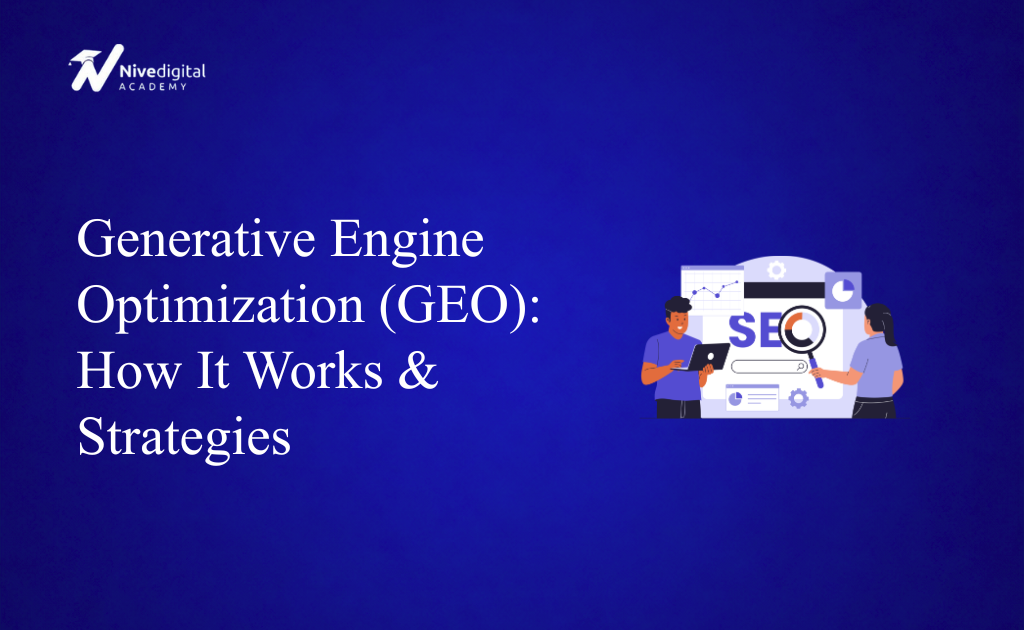
This shift has introduced a new approach to digital visibility known as Generative Engine Optimization (GEO).
While traditional SEO focuses on ranking web pages in search engine results, GEO focuses on increasing the likelihood that your content is cited, referenced, or used in AI-generated responses.
If businesses want to remain visible in the AI era, they need to optimize not only for Google Search but also for AI-powered search experiences.
In this guide, you’ll learn what Generative Engine Optimization is, how it works, why it matters, and the best strategies to improve your visibility in 2026.
What Is Generative Engine Optimization (GEO)?
Generative Engine Optimization (GEO) is the process of creating and optimizing content so that AI-powered search engines and generative AI platforms can easily understand, trust, and use it when generating answers for users.
Instead of only trying to rank on search engine results pages (SERPs), GEO focuses on becoming a trusted source that AI systems reference when answering questions.
Examples of AI-powered platforms include:
- ChatGPT
- Google AI Overviews
- Google AI Mode
- Microsoft Copilot
- Gemini
- Perplexity AI
As more users rely on conversational AI, optimizing for these platforms is becoming an important part of modern digital marketing.
How Is GEO Different From Traditional SEO?
Although GEO and SEO share many principles, they have different goals.
| Traditional SEO | Generative Engine Optimization |
|---|---|
| Optimizes for search rankings | Optimizes for AI-generated answers |
| Focuses on search result pages | Focuses on AI citations and references |
| Measures rankings and organic traffic | Measures AI visibility and brand mentions |
| Relies heavily on keywords | Prioritizes context, authority, and clarity |
| Targets clicks | Targets inclusion in AI responses |
Rather than replacing SEO, GEO complements it. Strong SEO often provides the foundation for successful GEO.
Why GEO Matters in 2026
Search behavior is changing rapidly.
Instead of clicking through multiple websites, many users now ask AI assistants questions and receive detailed answers instantly.

For businesses, this means:
- Greater competition for visibility
- Fewer clicks from some informational searches
- Increased importance of being recognized as a trusted source
- New opportunities to reach users through AI-generated responses
Brands that adapt early can build authority and maintain visibility as AI-powered search continues to grow.
How Generative AI Finds Information
Generative AI systems use a combination of:
- Publicly available web content
- Search engine indexes
- Structured data
- Trusted publications
- Knowledge bases
- High-authority websites
- Fresh and relevant content
AI models evaluate information based on factors such as relevance, clarity, consistency, and credibility.
Content that clearly answers questions and demonstrates expertise is more likely to be useful in AI-generated responses.
Key Factors That Influence GEO
Several factors increase the likelihood that your content will be referenced by AI systems.
These include:
- High-quality content
- Clear structure
- Demonstrated expertise
- Accurate information
- Topical authority
- Strong brand reputation
- Helpful answers
- Fresh content
- Technical accessibility
No single factor guarantees inclusion, but improving these areas strengthens your overall visibility.
1. Create Helpful, Comprehensive Content
AI systems aim to provide complete and useful answers.
Instead of publishing short articles, create content that thoroughly covers a topic.
Include:
- Definitions
- Benefits
- Step-by-step instructions
- Examples
- Best practices
- Common mistakes
- Frequently asked questions
Comprehensive content is more likely to answer a wide range of user queries.
2. Focus on Topical Authority
Rather than publishing isolated articles, build content clusters around your area of expertise.
For example, a digital marketing website could cover:
- SEO
- Local SEO
- Technical SEO
- Google Ads
- Facebook Ads
- Content Marketing
- Email Marketing
- AI Marketing
Publishing multiple high-quality articles on related subjects helps establish authority.
3. Write in a Clear, Conversational Style
AI systems work well with content that is:
- Easy to read
- Well organized
- Direct
- Factually accurate
Use:
- Short paragraphs
- Descriptive headings
- Bullet points
- Tables
- Simple explanations
Avoid unnecessary jargon and overly complicated language.
4. Answer Questions Directly
Many AI responses begin with concise answers before providing additional context.
Follow the same approach in your content.
For example:
What is Local SEO?
Local SEO is the process of optimizing a business to appear in local search results on Google and other search engines.
Then expand on the answer with more details.
5. Build Trust and Credibility
AI systems are more likely to rely on content that appears trustworthy.
Strengthen credibility by:
- Publishing accurate information
- Updating outdated content
- Correcting errors promptly
- Demonstrating real expertise
- Maintaining a professional website
Trust is becoming increasingly important in AI-driven search.
6. Use Structured Content
Well-structured pages are easier for both users and AI systems to understand.
Organize content using:
- H1 headings
- H2 headings
- H3 headings
- Numbered lists
- Bullet points
- Tables
- FAQs
Logical organization improves readability and information retrieval.
7. Optimize for Search Intent
Understand why users are searching.
Common intent categories include:
- Informational
- Navigational
- Commercial
- Transactional
Your content should fully satisfy the user’s intent, not just include the right keywords.
8. Publish Original Insights
AI systems can benefit from content that offers unique perspectives.
Consider adding:
- Original research
- Industry observations
- Case studies
- Personal experience
- Data analysis
- Expert opinions
Unique content helps differentiate your website from competitors.
9. Strengthen Your Brand Authority
Well-known and trusted brands are more likely to be recognized across the web.
Build authority by:
- Publishing consistently
- Earning quality backlinks
- Appearing in reputable publications
- Speaking at industry events
- Building an active online presence
A strong brand can improve both traditional SEO and GEO.
10. Keep Content Updated
AI-powered search favors accurate and current information.
Review important content regularly to:
- Update statistics
- Add new trends
- Refresh screenshots
- Remove outdated advice
- Expand sections where needed
Fresh content remains more useful to users and AI systems alike.
Best Practices for Generative Engine Optimization
To improve your visibility in AI-powered search:
- Create content that answers real user questions.
- Cover topics comprehensively.
- Use descriptive headings and logical structure.
- Demonstrate expertise with accurate information.
- Build topical authority through related content.
- Add FAQ sections where appropriate.
- Improve page speed and mobile usability.
- Use descriptive internal links.
- Update evergreen content regularly.
- Build a trustworthy online reputation.
These practices also strengthen your traditional SEO performance.
Common GEO Mistakes
Avoid these common mistakes:
- Publishing thin or superficial content.
- Writing only for keywords instead of users.
- Ignoring content updates.
- Providing inaccurate information.
- Creating duplicate content.
- Covering too many unrelated topics.
- Using clickbait headlines that don’t match the content.
- Neglecting technical SEO.
- Failing to build authority within your niche.
Quality and trust matter more than ever in the age of AI.
GEO vs SEO: Which Is More Important?
The answer is both.
Traditional SEO remains essential for attracting organic traffic from search engines.
Generative Engine Optimization prepares your content for AI-powered search experiences.
Businesses that combine both strategies are better positioned for long-term visibility.
Think of GEO as an evolution of SEO rather than a replacement.
The Future of GEO
As AI assistants become more integrated into everyday search, GEO will likely become an increasingly important part of digital marketing.
Businesses should expect:
- More conversational search queries
- Greater emphasis on authoritative content
- Increased competition for AI citations
- Continued importance of technical SEO
- More focus on user experience and trust
Organizations that adapt early will be better prepared for the future of search.
Frequently Asked Questions (FAQs)
What is Generative Engine Optimization (GEO)?
Generative Engine Optimization (GEO) is the practice of optimizing content so AI-powered search engines and assistants can understand, trust, and use it when generating answers for users.
Is GEO replacing SEO?
No. GEO is not replacing SEO. Traditional SEO remains important for ranking in search engines, while GEO helps improve visibility within AI-generated responses. The two strategies work best together.
Which AI platforms benefit from GEO?
GEO can improve visibility on AI-powered platforms such as ChatGPT, Google AI Overviews, Google AI Mode, Microsoft Copilot, Gemini, and Perplexity AI.
How can I optimize my content for AI search?
Focus on creating accurate, comprehensive, and well-structured content that directly answers user questions, demonstrates expertise, and stays up to date.
Does GEO require technical SEO?
Yes. Technical SEO supports GEO by making your content easier to crawl, understand, and access. Fast-loading pages, mobile-friendly design, structured data, and clean site architecture all contribute to better visibility.
Are keywords still important in GEO?
Yes, but they are no longer the primary focus. Context, relevance, clarity, and search intent are increasingly important alongside natural keyword usage.
How do I measure GEO success?
Unlike traditional SEO, GEO success is not measured only by rankings. Look for increases in branded searches, referral traffic from AI platforms where measurable, overall organic visibility, mentions of your brand, and growth in topical authority.
Is Generative Engine Optimization worth investing in?
Yes. As AI-powered search continues to grow, businesses that optimize for both traditional search engines and generative AI platforms will be better positioned to reach users and maintain online visibility.
Conclusion
Generative Engine Optimization represents the next stage in the evolution of search. As more users turn to AI assistants for answers, businesses need to think beyond traditional rankings and focus on creating content that is trustworthy, comprehensive, and genuinely helpful.
By combining strong SEO fundamentals with GEO best practices—such as building topical authority, answering questions clearly, publishing original insights, and maintaining accurate, well-structured content—you can improve your chances of being discovered not only through search engines but also through the AI-powered experiences shaping the future of online search.