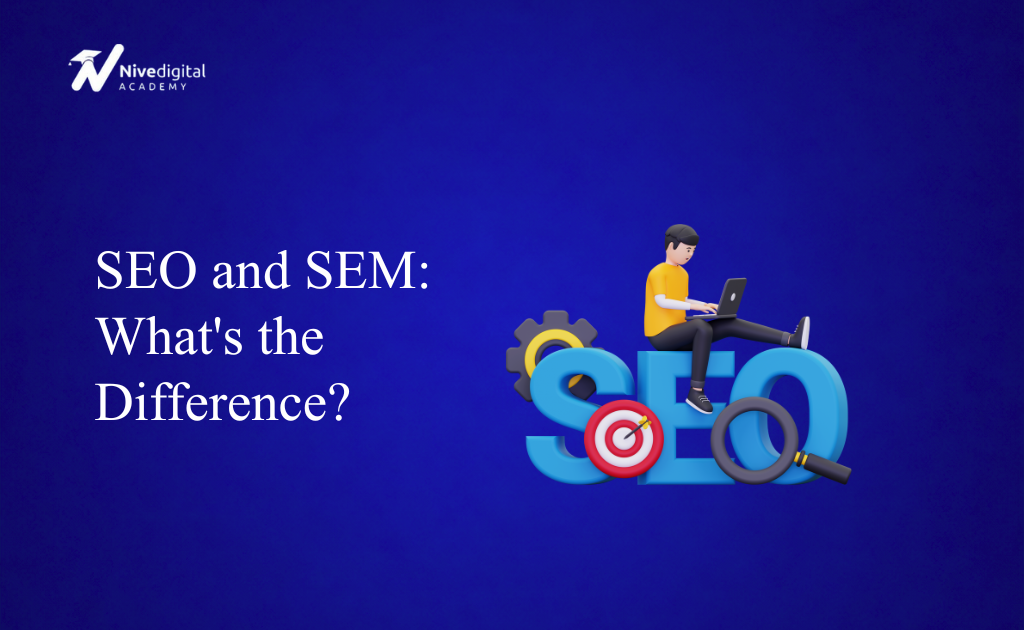
\If you’re new to digital marketing, you’ve probably come across the terms SEO and SEM. While they are closely related, they are not the same thing. Both are designed to increase a website’s visibility on search engines like Google, but they achieve this in different ways.
NiveDigital Academy is a leading digital marketing training institute in Nigeria. Learn practical digital marketing skills, master SEO, social media marketing, Google Ads, content marketing, and more — and build the skills you need to grow a business, get clients, or start a career in digital marketing.
Understanding the difference between SEO and SEM is important whether you’re a business owner trying to grow your online presence or someone planning to build a career in digital marketing.
In this guide, you’ll learn what SEO and SEM are, how they work, their differences, advantages, disadvantages, and which strategy is best for businesses in Nigeria.
What Is SEO?
SEO (Search Engine Optimization) is the process of improving a website so it ranks higher in the organic (free) search results on search engines like Google.
The goal of SEO is to attract visitors without paying for every click.
SEO involves several strategies, including:
- Keyword research
- On-page SEO
- Technical SEO
- Local SEO
- Content optimization
- Link building
- User experience optimization
Good SEO helps websites gain long-term visibility and consistent organic traffic.
What Is SEM?
SEM (Search Engine Marketing) is a digital marketing strategy that uses paid advertising to increase a website’s visibility on search engines.
The most common form of SEM is Google Ads, where businesses bid on keywords to display their ads above or below the organic search results.
With SEM, businesses pay when users click on their advertisements.
SEM typically includes:
- Google Search Ads
- Display Ads
- Shopping Ads
- Performance Max Campaigns
- Remarketing Campaigns
SEM provides immediate visibility and faster results than SEO.
SEO vs SEM: Key Differences
Although both aim to increase website traffic, they work differently.
| Feature | SEO | SEM |
|---|---|---|
| Traffic Source | Organic search results | Paid search ads |
| Cost | No payment for clicks | Pay for every click |
| Speed | Long-term results | Immediate results |
| Ranking | Based on optimization and relevance | Based on bids, quality score, and relevance |
| Sustainability | Long-lasting | Stops when advertising budget ends |
| Click Cost | Free | Paid |
| Best For | Long-term growth | Quick traffic and lead generation |
The biggest difference is that SEO earns traffic naturally, while SEM uses paid advertising.
How SEO Works
SEO helps search engines understand your website and determine whether it deserves to rank for certain searches.
SEO involves improving several areas of your website, including:
Keyword Research
Finding the words and phrases people search for on Google.
Content Creation
Publishing useful, high-quality content that answers users’ questions.
On-Page SEO
Optimizing titles, headings, URLs, images, and internal links.
Technical SEO
Improving website speed, mobile friendliness, crawlability, and indexing.
Link Building
Earning quality backlinks from other websites to improve authority.
SEO requires patience because rankings usually improve over time.
How SEM Works
SEM relies on paid advertising.
The basic process is:
- Choose keywords.
- Create advertisements.
- Set a budget.
- Target your audience.
- Launch campaigns.
- Monitor performance.
- Optimize for better results.
When users search for your chosen keywords, your ads may appear at the top of Google’s search results.
You only pay when someone clicks on your ad.
Advantages of SEO
SEO offers several long-term benefits.
These include:
- Free organic traffic
- Long-lasting results
- Higher credibility
- Better return on investment over time
- Increased brand awareness
- Higher website authority
- Better user experience
- Sustainable business growth
SEO is often considered one of the most cost-effective digital marketing strategies.
Advantages of SEM
SEM offers several unique benefits.
These include:
- Immediate visibility
- Fast lead generation
- Precise audience targeting
- Flexible budgets
- Measurable results
- Easy campaign adjustments
- Ideal for product launches
- Quick testing of marketing ideas
Businesses needing immediate traffic often choose SEM.
Disadvantages of SEO
SEO also has some limitations.
Examples include:
- Results take time.
- Competition can be high.
- Google algorithms change regularly.
- Continuous optimization is required.
- Rankings are not guaranteed.
Despite these challenges, SEO provides long-term value.
Disadvantages of SEM
SEM has its own challenges.
These include:
- Ongoing advertising costs
- High competition for keywords
- Rising cost-per-click
- Traffic stops when campaigns end
- Requires careful budget management
SEM works best when campaigns are properly optimized.
When Should You Choose SEO?
SEO is ideal if you want:
- Long-term traffic
- Sustainable business growth
- Better search rankings
- Lower long-term marketing costs
- Strong online authority
- Continuous organic visitors
SEO is especially valuable for businesses looking to build lasting online visibility.
When Should You Choose SEM?
SEM is the better option if you need:
- Immediate website traffic
- Fast lead generation
- Quick product promotion
- Event marketing
- Seasonal campaigns
- Rapid testing of offers
SEM is excellent for businesses that need quick results.
Can SEO and SEM Work Together?
Yes.
In fact, many successful businesses combine both strategies.
For example:
- Use SEM to generate immediate traffic.
- Build SEO for long-term organic growth.
- Use SEO content to reduce advertising costs over time.
- Use SEM data to identify high-converting keywords for SEO.
Combining both approaches often delivers the best results.
SEO vs SEM: Which Is Better?
The answer depends on your goals.
Choose SEO if you want:
- Long-term growth
- Organic traffic
- Better return on investment over time
- Sustainable visibility
Choose SEM if you want:
- Immediate traffic
- Fast sales
- Quick lead generation
- Time-sensitive promotions
Many businesses in Nigeria use both strategies to maximize their online success.
Career Opportunities in SEO and SEM
Both fields offer rewarding careers.
Popular SEO careers include:
- SEO Specialist
- Technical SEO Expert
- SEO Consultant
- Content SEO Writer
- Local SEO Specialist
Popular SEM careers include:
- Google Ads Specialist
- PPC Manager
- Search Engine Marketing Specialist
- Paid Media Manager
- Performance Marketing Specialist
Professionals who understand both SEO and SEM are highly sought after.
SEO vs SEM Salary in Nigeria
Professionals with SEO and SEM skills are among the highest-paid digital marketers.
Typical monthly earnings include:
SEO Professionals
- Beginner: ₦120,000–₦300,000
- Intermediate: ₦300,000–₦700,000
- Experienced: ₦700,000–₦2,000,000+
SEM Professionals
- Beginner: ₦150,000–₦350,000
- Intermediate: ₦350,000–₦800,000
- Experienced: ₦800,000–₦2,500,000+
Freelancers and consultants often earn significantly more by managing multiple clients.
How to Learn SEO and SEM
If you’re starting your digital marketing journey, follow these steps:
- Learn SEO fundamentals.
- Understand keyword research.
- Learn on-page and technical SEO.
- Study Google Ads.
- Learn campaign optimization.
- Understand Google Analytics.
- Practice on real websites.
- Build a portfolio.
- Stay updated with Google’s changes.
- Continue learning AI-powered marketing tools.
Practical experience is essential for mastering both disciplines.
Frequently Asked Questions (FAQs)
What is the difference between SEO and SEM?
SEO focuses on improving a website’s organic rankings through optimization, while SEM uses paid advertisements to increase visibility on search engines.
Is SEO part of SEM?
Yes. Traditionally, SEM was considered an umbrella term that included both paid and organic search marketing. However, today many marketers use SEM specifically to refer to paid search advertising, while SEO refers to organic optimization.
Which is better for small businesses?
It depends on your goals. SEO is ideal for long-term growth and reducing customer acquisition costs, while SEM is better for businesses that need immediate traffic and faster results.
Do I need both SEO and SEM?
Not necessarily, but combining both strategies often delivers the best results. SEO builds long-term visibility, while SEM provides immediate exposure.
Is Google Ads part of SEM?
Yes. Google Ads is the most widely used platform for Search Engine Marketing (SEM).
Which is more affordable?
SEO usually offers a better long-term return on investment because you don’t pay for each click. SEM requires an ongoing advertising budget.
Is SEO still important in 2026?
Absolutely. SEO remains one of the most effective digital marketing strategies for generating sustainable organic traffic and improving online visibility.
Where can I learn SEO and SEM in Nigeria?
If you’re looking for practical digital marketing training, Nivedigital Academy offers hands-on courses covering SEO, Google Ads, keyword research, technical SEO, Local SEO, analytics, AI marketing, and real-world projects that prepare students for freelance, remote, and full-time careers in Nigeria.
Conclusion
SEO and SEM are both powerful digital marketing strategies, but they serve different purposes. SEO focuses on building long-term organic visibility through website optimization and quality content, while SEM delivers immediate results through paid search advertising.
Rather than choosing one over the other, many successful businesses use both strategies together to maximize traffic, leads, and sales. SEO provides sustainable growth over time, while SEM helps businesses achieve quick wins and reach customers faster.
As digital marketing continues to grow in Nigeria, professionals who understand both SEO and SEM will remain in high demand. If you’re ready to develop practical, job-ready digital marketing skills, Nivedigital Academy offers hands-on training to help you master both disciplines and build a successful career.