Data analytics has become one of the fastest-growing career fields in Nigeria. As businesses generate more digital data every day, organizations need professionals who can analyze that information and turn it into valuable business insights.
NiveDigital Academy is a leading digital marketing training institute in Nigeria. Learn practical digital marketing skills, master SEO, social media marketing, Google Ads, content marketing, and more — and build the skills you need to grow a business, get clients, or start a career in digital marketing.
From banks and fintech companies to hospitals, telecommunications firms, government agencies, and e-commerce businesses, data analytics is helping organizations improve decision-making, increase efficiency, reduce costs, and understand customer behavior.
The demand for skilled data analysts continues to rise, making it one of the most promising career paths for students, graduates, and working professionals looking to build a successful future.
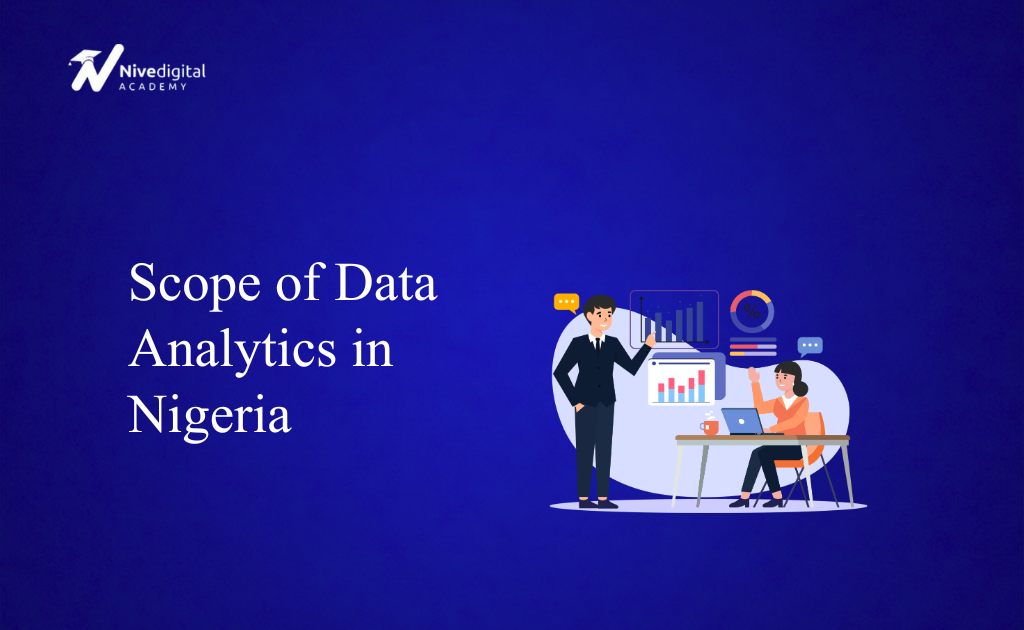
In this guide, we’ll explore the scope of data analytics in Nigeria, the industries hiring data analysts, career opportunities, salaries, future trends, and why this field is expected to grow even further beyond 2026.
What Is Data Analytics?
Data analytics is the process of collecting, cleaning, organizing, analyzing, and interpreting data to help organizations make informed decisions.
Businesses use data analytics to answer important questions such as:
- Which products sell the most?
- What do customers want?
- Which marketing campaigns generate the best results?
- How can operating costs be reduced?
- Where can business performance improve?
Instead of relying on assumptions, organizations use data to make smarter decisions.
Why Data Analytics Is Growing in Nigeria
Several factors are driving the rapid growth of data analytics across Nigeria.
These include:
- Increased internet usage
- Growth of fintech companies
- Expansion of e-commerce
- Digital transformation
- Artificial Intelligence (AI)
- Cloud computing
- Increased smartphone usage
- More businesses collecting customer data
As organizations become more data-driven, skilled analysts are becoming essential.
Scope of Data Analytics in Nigeria
The opportunities in data analytics continue to expand across multiple industries.
Below are some of the sectors where data analysts are in high demand.
Banking and Financial Services
Banks use data analytics to:
- Detect fraud
- Assess financial risks
- Improve customer experience
- Analyze spending habits
- Personalize financial products
Financial institutions rely heavily on data to improve operations and increase profitability.
Fintech
Nigeria has one of Africa’s fastest-growing fintech ecosystems.
Fintech companies use data analytics for:
- Customer insights
- Transaction monitoring
- Credit scoring
- Fraud prevention
- Product improvement
- Business intelligence
This sector continues to create numerous opportunities for data professionals.
Healthcare
Hospitals and healthcare organizations analyze data to:
- Improve patient care
- Track disease trends
- Manage hospital resources
- Predict healthcare needs
- Reduce operational costs
Healthcare analytics is becoming increasingly important.
E-commerce
Online retailers rely on analytics to understand:
- Customer behavior
- Buying patterns
- Product demand
- Website performance
- Marketing effectiveness
Data helps e-commerce businesses improve sales and customer satisfaction.
Telecommunications
Telecommunication companies analyze massive amounts of customer data.
Analytics supports:
- Network optimization
- Customer retention
- Usage analysis
- Service improvement
- Revenue forecasting
The telecom sector remains one of the largest employers of data professionals.
Education
Educational institutions use analytics to:
- Monitor student performance
- Improve learning outcomes
- Predict student retention
- Optimize resource allocation
The education sector is increasingly adopting data-driven decision-making.
Government
Government agencies use analytics for:
- Policy planning
- Population analysis
- Budget management
- Public health
- Security planning
- Economic development
Data-driven governance is becoming more common.
Manufacturing
Manufacturers use analytics to:
- Improve production efficiency
- Reduce waste
- Predict equipment maintenance
- Optimize supply chains
Analytics improves productivity and reduces costs.
Retail
Retail businesses analyze customer data to:
- Forecast demand
- Manage inventory
- Improve pricing
- Personalize marketing
- Increase customer loyalty
Retail analytics helps businesses remain competitive.
Marketing and Advertising
Marketing agencies use analytics to measure:
- Campaign performance
- Website traffic
- Customer engagement
- Conversion rates
- Return on investment (ROI)
Analytics helps businesses maximize their marketing budgets.
Career Opportunities in Data Analytics
The demand for skilled professionals continues to increase.
Popular career paths include:
- Data Analyst
- Business Analyst
- Business Intelligence Analyst
- Marketing Analyst
- Financial Analyst
- Operations Analyst
- Product Analyst
- Data Visualization Specialist
- Reporting Analyst
- Data Consultant
- Analytics Manager
- Risk Analyst
Many professionals also work remotely for international companies.
Skills Required for Data Analytics
To succeed as a data analyst, you’ll need both technical and workplace skills.
Technical skills include:
- Microsoft Excel
- SQL
- Power BI
- Tableau
- Python
- Statistics
- Data Visualization
- Data Cleaning
- Artificial Intelligence (AI)
Soft skills include:
- Communication
- Critical Thinking
- Problem-Solving
- Attention to Detail
- Teamwork
- Time Management
- Business Understanding
Combining technical and analytical thinking makes you more valuable to employers.
Data Analytics Salary in Nigeria
Data analytics offers excellent earning potential.
Typical monthly salary ranges include:
- Entry-level: ₦150,000–₦350,000
- Mid-level: ₦350,000–₦800,000
- Senior-level: ₦800,000–₦2,500,000+
Professionals working with international companies or as freelance consultants often earn considerably more.
Benefits of Choosing Data Analytics as a Career
There are many reasons why people choose data analytics.
Some of the biggest advantages include:
- High demand
- Competitive salaries
- Remote work opportunities
- Career flexibility
- Continuous learning
- Strong job security
- Global career opportunities
- Opportunities across multiple industries
These benefits make data analytics one of the most attractive technology careers.
Challenges in Data Analytics
Like any profession, data analytics has its challenges.
Common challenges include:
- Cleaning messy datasets
- Working with large volumes of information
- Meeting project deadlines
- Learning new technologies
- Protecting sensitive data
- Explaining technical insights to non-technical audiences
Continuous learning helps professionals overcome these challenges.
Future of Data Analytics in Nigeria
The future of data analytics in Nigeria looks extremely promising.
Several trends will continue driving demand.
Artificial Intelligence
AI is helping analysts automate repetitive tasks and analyze larger datasets more efficiently.
Big Data
Organizations continue collecting larger amounts of information every year.
Managing and analyzing big data requires skilled professionals.
Cloud Computing
Cloud platforms allow businesses to store and analyze data more efficiently.
Knowledge of cloud-based analytics tools is becoming increasingly valuable.
Business Intelligence
Companies are investing more in dashboards and real-time reporting to improve decision-making.
Data-Driven Decision Making
Organizations increasingly rely on data instead of assumptions when planning business strategies.
This trend is expected to continue for many years.
How to Start a Career in Data Analytics
If you’re interested in becoming a data analyst, follow these steps:
- Learn Microsoft Excel.
- Study SQL.
- Learn statistics.
- Master Power BI or Tableau.
- Learn Python.
- Practice with real datasets.
- Build dashboards.
- Create a portfolio.
- Apply for internships or entry-level jobs.
- Continue learning as new technologies emerge.
Practical experience is one of the biggest factors employers consider.
Frequently Asked Questions (FAQs)
Is data analytics in demand in Nigeria?
Yes. Data analytics is one of the fastest-growing careers in Nigeria, with increasing demand across banking, fintech, healthcare, telecommunications, e-commerce, education, and government sectors.
What is the scope of data analytics?
Data analytics has a broad scope because organizations across nearly every industry rely on data to improve decision-making, increase efficiency, reduce costs, and understand customer behavior.
Which industries hire data analysts in Nigeria?
Major employers include banks, fintech companies, telecommunications firms, hospitals, schools, government agencies, retail businesses, marketing agencies, and e-commerce companies.
Is data analytics a good career?
Yes. Data analytics offers excellent salaries, strong job security, career flexibility, remote work opportunities, and high demand both in Nigeria and internationally.
What skills do I need to become a data analyst?
Key skills include Microsoft Excel, SQL, Power BI, Tableau, Python, statistics, data visualization, communication, and problem-solving.
Can I become a data analyst without a degree?
Yes. Many employers focus more on practical skills, certifications, portfolios, and real-world experience than on formal academic qualifications.
How long does it take to learn data analytics?
Most beginners can develop entry-level data analytics skills within four to eight months through consistent learning and practical projects.
Where can I learn data analytics in Nigeria?
If you’re looking to develop practical digital skills, Nivedigital Tech School offers hands-on training in digital technologies, analytics, AI tools, and other career-focused programs designed to prepare students for today’s job market in Nigeria.
Conclusion
The scope of data analytics in Nigeria continues to expand as more organizations embrace digital transformation and data-driven decision-making. Businesses across industries are investing in analytics to improve operations, understand customers, reduce costs, and gain a competitive advantage.
For individuals, this growth translates into exciting career opportunities, competitive salaries, and the chance to work in diverse industries or even remotely for international employers. As technologies like Artificial Intelligence, cloud computing, and business intelligence continue to evolve, the demand for skilled data analysts will only increase.
If you’re looking to build a future-proof career in Nigeria, data analytics is one of the smartest choices you can make. Nivedigital Tech School provides practical, hands-on training to help you develop the technical skills, real-world experience, and confidence needed to succeed in this rapidly growing field.